

Rocklin Golf Courses - Roseville California News including Rocklin & Placer County

 Roseville Newspaper and Yellow Pages Online masthead logo


Jobs  News  Movie Times  Log In  Contact  RSS  Advertise   
 

Rocklin Golf Courses

credit: Gary Day, Jean Day -photos (Rocklin Historical Society)
 RSS Feed  Print version   

articles_historyseries08.jpgRocklin challenges golfers with two top-tier golf venues, Whitney Oaks Golf Course and the course at the Sunset Whitney Country Club. But in the late 19th century Rocklin was also home to one of California’s first golf courses, a nine-hole circuit in the middle of the Whitney Ranch.
George Whitney established the Whitney Ranch in 1857 when he purchased 320 acres of rangeland west of downtown Rocklin to run a special crossbreed of Australian and California sheep. His son, Joel Parker Whitney, called Parker then, gained control of the ranch in the early 1870s, diversified its activities and expanded it to about 20,000 acres during the next 30 years.

By the early 1880s Parker was wealthy from his Colorado mining investments. He decided to transform parts of the ranch into a baronial estate to flaunt his wealth and to provide a permanent home for his wife Lucy and the couple’s three small children. He built his 20-room Oaks mansion in the mid 1880s and connected it to downtown Rocklin, three miles away, by improving and extending the ranch’s decomposed granite roads. Parker was enamored of English Society. He traveled to England yearly and built most of the twelve bridges on his road to Rocklin in the style of stone bridges of the English countryside.

In the late 1880s Parker founded the Placer County Citrus Colony to lure Englishmen to purchase small citrus ranches in Clover Valley and on the flatter lands to the north and east in Loomis and Penryn.

In the 1890s, as today, golf was a favored sport among Englishmen. English golf professionals were popularizing golf on America’s east coast and Parker decided to please his English friends and provide recreation for ranch visitors and his family by building his nine holes on the slope of the knoll below the Oaks and on the surrounding lower terrain. A modern 9-hole course would occupy about 75 acres but history does not record the exact layout of Parker’s course. A photo from the very early 20th century shows the tee for one hole near a boulder now at the corner of Hanover and Kali in Rocklin’s Claremont neighborhood, about a quarter mile southeast of the Oaks’ knoll.

Parker’s diary indicates that he completed course construction in the late 1890s and that the course was still playable at the turn of the century. It must have been well maintained until at least 1910 because Parker touted it as a ranch feature when he tried, but failed, to sell his ranch that year.

When Parker died in 1913 Lucy moved out of the Oaks, and with the children gone the course probably started to deteriorate, with the land returning to its natural state. Whitney historian Richard Miller lived at the Oaks when his family leased the northern half of the ranch and ran cattle there in the late 1930s. Miller remembers that only vestiges of the course were visible then. Parker’s golf course is now covered by residential neighborhoods near Mansion Oaks Park.

Sunset International Petroleum Corporation built Rocklin’s second golf course, Sunset Oaks, in the early 1960s. It opened for play in June 1963. It is at the foot of Clover Valley surrounding Sunset Hill and it extends southward toward Roseville. Sunset Oaks was the centerpiece of a self-contained metropolis that Sunset intended to develop on the southern 12,000 acres of the Whitney Ranch.   Sunset built their course to PGA competition standards in order to host an annual PGA tournament, the Sunset Camellia Open. According to former Sunset Vice President Dale Stringfellow, Sunset was flush with cash from the sale of a Southern California oil refinery at that time and spent willingly to ensure that the pros had the best of championship conditions, including specially constructed greens.

Sunset also provided access under Midas Avenue to a planned 9-hole executive course on the north border of Sunset Oaks in lower Clover Valley.

California touring golf pro Bob McAllister won the first Sunset Camellia Open in October 1964. But big name pros like Arnold Palmer and Jack Nicklaus didn’t appear and, despite intensive coverage by local media, galleries were thin. This tournament was Rocklin’s first and only experience with top PGA touring pros and its failure to draw big crowds was a marker for slow home sales and the demise of the Sunset City project in the mid 1960s, National Golf Courses Corporation bought Sunset Oaks in 1966 and changed the name to Sunset Whitney Ranch. A later owner changed the name to Sunset Whitney Country Club.

Today’s owner at the country club plans to improve clubhouse facilities and build residences on course property The site of Sunset’s planned executive course is now covered by a residential neighborhood along Rawhide Avenue. 

According to Rocklin City staff, Rocklin’s third golf course, Whitney Oaks, started life in the early 1990s as a Landmark Land Development Company course called Stanford Oaks. Landmark encountered financial problems and abandoned the project before starting construction. Live Oak Enterprises built Whitney Oaks Golf Course in the mid 1990s on the land intended for Stanford Oaks. The course opened for play in 1997.
Whitney Oaks covers the middle of a 250+ acre canyon-like valley which was the vineyard and orchard in the late 19th century of Parker’s friend O.T. Brown. Parker provided water to Brown’s valley in the late 19th century. In return Brown willed the valley to Parker. Brown Died in 1901 and Parker integrated the valley into the Whitney ranch.


Rocklin and the magical seventeen
Was there something special about their years training in Rocklin that brought the San Francisco 49ers from obscurity to greatness, and then back to obscurity when they left? Is there something special about Rocklin?
A Haven for Hoboes
Rocklin's location at the terminus of the westbound trans-Sierra run made it a magnet for freight train hoboes. Sensing that they were at the valley floor after a tortuous boxcar ride downhill from Norden, hoboes disembarked to rest, and possibly to wander in the area seeking better lives.
Twelve Bridges
Much of western Rocklin is astride the southern 12,000 acres of the Spring Valley Ranch of the late 19th and early 20th centuries. This is property which Rocklin annexed while the city's population grew during the past 45 years
Run Rocklin
On March 14, 2004, Run Rocklin, called Rocklin Run for the Gold then, raised $8,000 to save Rocklin’s oldest public building from the wrecking ball.
Rocklin Golf Courses
Rocklin challenges golfers with two top-tier golf venues, Whitney Oaks Golf Course and the course at the Sunset Whitney Country Club. But in the late 19th century Rocklin was also home to one of California’s first golf courses, a nine-hole circuit in the middle of the Whitney Ranch.
Delano's Quarry
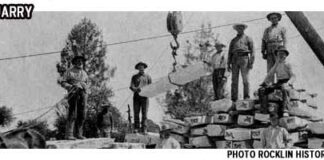
According to state records Rocklin was the principal granite producing point in the Sacramento Valley in the late 19th and early 20th centuries. Rocklin’s largest and most financially-successful quarry operation of those times was Ira Delano’s Rocklin Granite Company.
Rocklin Hose Company Number One
In the early 1890s, demand for Rocklin’s light-gray granite building stone grew steadily and Rocklin’s quarries were at peak activity. Rocklin’s railroad roundhouse employed 300 people and businesses flourished along Granite Avenue (now Rocklin Road),
Whence Came the Altar Stone
The Rocklin Historical Society is restoring a 124 year old church on Front Street in downtown Rocklin. When RHS completes the restoration in September 2007, the church will be primarily a non-denominational wedding chapel.
Oskari’s Journey
Eighteen-year-old Oskari left Russian-ruled Finland and came to New York in 1891. He was one of 350,000 Finns who came to America escaping Finland’s harsh political and economic conditions in the late 19th and early 20th centuries.
A Twenty Minute Tour of Rocklin History
The Rocklin History Museum is open from 1 pm until 4 pm on Wednesday, Saturday and Sunday afternoons. If you are in the mood for Rocklin’s history at other times, try this 20 minute tour of two sites which were important to Rocklin’s role as the Sacramento Valley’s major producer of granite products in the late 19th and early 20th centuries.
Rocklin Goes to the Races
In 1895 horse doctor Mansfield Delano and his wealthy brother Ira, owner of Rocklin’s most successful granite quarry, led a group of nine investors to form the Rocklin Driving Park Association and build Rocklin’s first and only race track.
The Crowd in the Pyramid
The pyramid-shaped Whitney family tomb is an often photographed curiosity near the 11th green of the Whitney Oaks Golf Course.
History doesn’t record the tomb’s construction date but one family member theorizes that
Rocklin's Pyramid Tomb?
In January 1913, Joel Parker Whitney, called Parker then, died at Del Monte California after a long bout with kidney disease. He was 78. According to Richard Miller’s Fortune Built by Gun, Parker had prepared a pyramid-shaped mausoleum for himself...
Porter's Saloon Token Brings $325
On December 19, 2005 an unidentified collector paid $325.00 for a Porter’s Saloon trade token at a Western Americana auction in Reno.
Dewitt Porter’s Saloon was a popular downtown Rocklin watering hole in the late 19th and early 20th centuries.
Major Professional Golf in Rocklin
The year was 1964. Lyndon Johnson promised a quick victory in Vietnam and was elected President over Barry Goldwater. Arnold Palmer won the Masters for what turned out to be the last time. Rocklin’s population was about 1,600
Clover Valley
According to Sierra College Geology Professor Dick Hilton, the valley started to form five million years ago as the Sierra range lifted and tilted westward. Runoff streams wore down millions of years of rock and gravel deposits
Saint Mary's through the Years
In 1882 John Bolton, the Irish land developer who plotted Rocklin’s original town site, donated an oak framed lot to Rocklin’s Catholics for our City’s first Catholic Church.
Whitney Ranch (3 of 3)
During the 1860’s and 1870’s Joel Parker Whitney, called Parker then, expanded his Spring Valley Ranch from 320 acres to 18,000 acres.
Whitney Ranch (2 of 3)
In 1857, Boston merchant George Whitney established a 320-acre sheep ranch near a small South Placer County granite quarrying community. That community would later supply stone for construction of
Whitney Ranch (1 of 3)
In 1854, Boston businessman George Whitney visited San Francisco to see the four oldest of his six sons. The four had come to California individually at various times during the Gold Rush and
Finn Hall
They dragged hay bales across the floor to make it slick, and then they danced to the music of Rocklin’s Echo Band until midnight. They adjourned upstairs for supper, rested awhile with the quarry-worker band members and then danced until 3 am.
Where did “Rocklin” come from?
Our city’s name first appeared in print in June 1864 when “Rocklin” was listed in a Central Pacific Railroad timetable as a stop between Junction (now Roseville) and Pino (now Loomis). But how did the name, “Rocklin”, originate?
Huff Spring
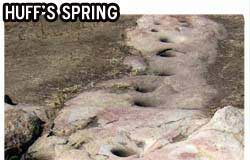
The spring was a widely known Rocklin curiosity and source of clean drinking water in the late 18th and early 19th centuries. A nearby cluster of 88 bedrock mortars and about 4 acres of gently sloping terrain, partly covered by Springview School’s soccer field, tell that the area was formerly home to a large community of native Nisenan.
Rocklin, A Town Built on Granite
Downtown Rocklin is astride a 100 square mile belt of high quality and easily accessible granite that extends from Folsom to Lincoln. Assisted by easy access to rail shipping, granite mining and creation of finished granite products formed the backbone of Rocklin’s economy
Holmes / Renaldi Shootout in 1914
In 1914, Rocklin’s once-booming granite industry was waning due to labor strife and competition from cement-based concrete. The Southern Pacific Railroad had moved Rocklin’s roundhouse to Roseville 6 years earlier. And a peace officer died in the line of duty for the...
Rocklin’s Roundhouse 1867 to 1908
In 1862, during the Civil War, the United States Congress authorized Federal incentives for construction of a rail line to connect eastern population centers with California. In January 1863 the Central Pacific Railroad started laying rails eastward from
Rocklin: Prosperous and Growing in the 19th Century
In February 1893, Rocklin’s population was expanding, its industrial base was solid and business was booming, so its electorate approved a ballot proposal to incorporated as a city.
Nisenan, Rocklin’s Earliest Culture
They built their villages on low rises along Rocklin’s streams, hunted game animals in Rocklin’s hills and meadows and gathered fruits, nuts, seeds and roots here for 2000 years before European explorers
Introduction to Rocklin History Series
Recent archeological evidence indicates earliest human habitation of the Rocklin area at about 7,000 years ago.


Local Business Offers

arrow View / Post

Local Events

9/9/2010
9/9/2010
9/9/2010
9/9/2010
9/10/2010
9/11/2010

arrow add event  arrow view all


LOCAL JOBS & EMPLOYMENT


LOCAL SPONSORS


About   |  Contact  |  Privacy Policy  |  Copyright © 2003-2010 Rocklin & Roseville Today   |  Advertise |   Payments | RSS      |  

Our Network:   Rocklin & Roseville   |   Sacramento   |   Folsom   |   Lincoln   |   Auburn